
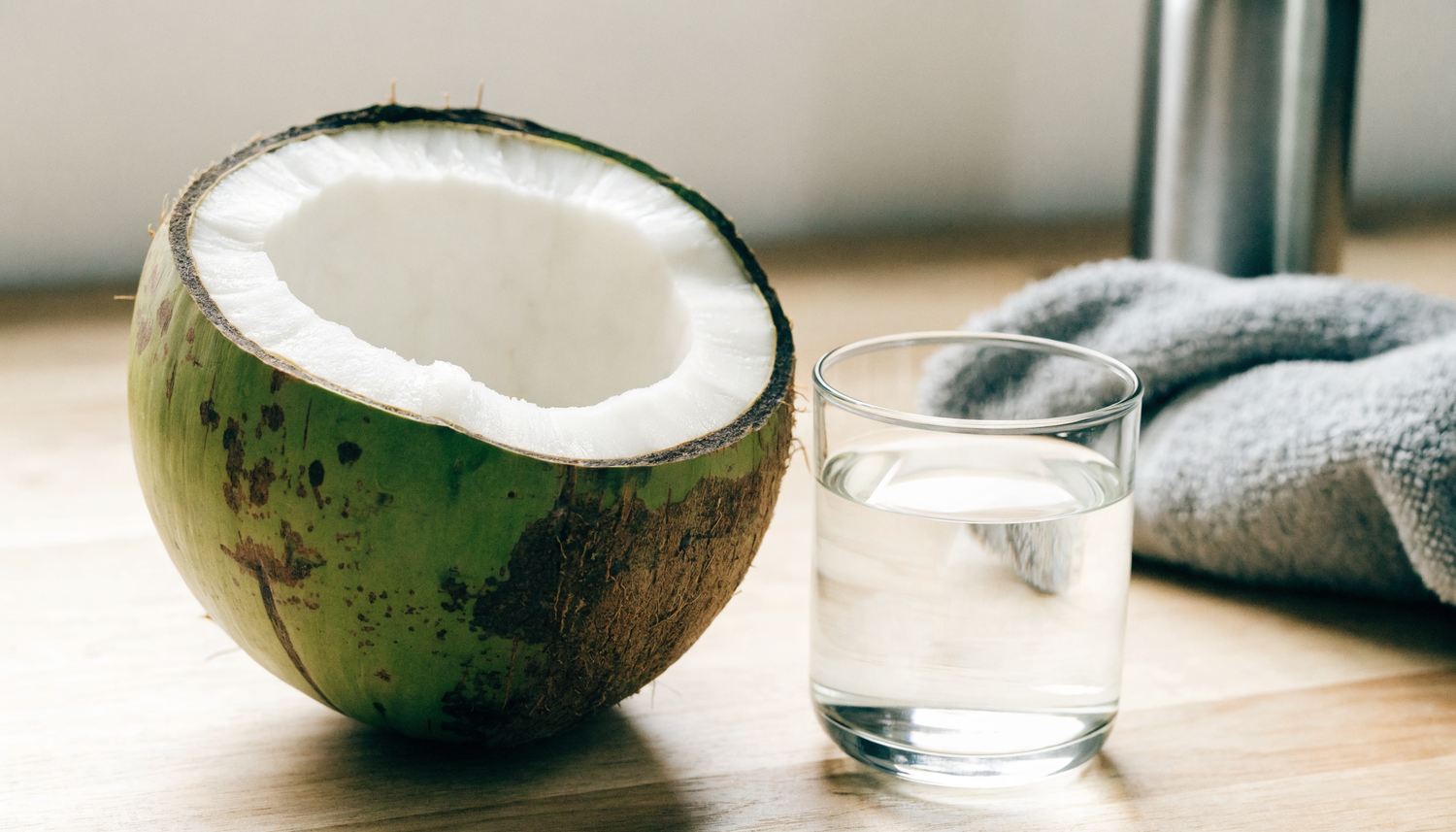
You've probably already seen an athlete finish a workout with a carton of coconut water in hand. This drink has earned a reputation as a miracle rehydrator, largely thanks to social media. The reality is more nuanced, and frankly more interesting. Here's what coconut water really brings to your hydration, its limitations, and the situations where it makes a difference.
Coconut water isn't coconut milk
Natural water, not a processed juice
Coconut water is the clear liquid naturally found inside young green coconuts, harvested before they are fully mature. It has nothing to do with coconut milk, which comes from grated and pressed coconut flesh and is much higher in fat and calories. Coconut water contains more than 95% water and around 15 kcal per 100 ml, making it very similar to plain water in terms of energy content.
A rather unusual mineral composition
Its mineral profile is what makes coconut water interesting for athletes. It contains the five electrolytes the human body uses: potassium, sodium, magnesium, calcium, and phosphorus. Potassium is by far the most abundant, generally ranging from 200 to 300 mg per 100 ml depending on the fruit's origin and level of ripeness. Few natural drinks offer such a high level without being enriched in a laboratory.
What coconut water really does for your hydration
Potassium, its real strength
When you sweat, you lose water as well as minerals. Potassium works mainly inside cells, while sodium acts outside them. Together, they regulate fluid balance and muscle contraction. A potassium-rich drink therefore helps replenish a store that many people neglect, especially in summer and particularly when their diet is low in fruit and vegetables.
Effective rehydration during moderate exercise
Several studies have compared coconut water with conventional sports drinks after mild to moderate dehydration. The conclusion is fairly consistent: it rehydrates just as well, sometimes slightly better than plain water, but never spectacularly so. In other words, during a 45-minute or one-hour session at a reasonable intensity, it does the job. It isn't magical; it's simply adequate, and above all natural.
Less sugar than most sports drinks
Pure coconut water contains around 4 to 5 g of sugar per 100 ml, compared with 6 to 8 g for a commercial isotonic drink, and sometimes more for a soda or conventional energy drink. These sugars occur naturally in the fruit rather than being added. For anyone looking to hydrate without consuming the equivalent of several sugar cubes, that's a real advantage.
A taste that encourages you to drink more
This factor is often overlooked, even though it matters enormously. The best rehydration drink is the one you actually drink. Lukewarm plain water at the bottom of a bottle isn't appealing. A slightly sweet, slightly salty, chilled liquid makes you want to drink more. The total volume consumed accounts for half the result, and taste drives that volume.
What to know before making it your sports drink
Too little sodium for long efforts
This is coconut water's real weakness. Sweat is rich in sodium, with losses commonly ranging from 400 to 1000 mg per liter of sweat depending on the individual. Coconut water, on the other hand, contains only around 25 to 60 mg of sodium per 100 ml. Sodium is precisely the mineral that helps your body retain the fluid you have just drunk. Without it, some of what you consume goes straight to the bathroom.
Not enough carbohydrates for endurance
After an hour of continuous exercise, your body needs carbohydrates, roughly 30 to 60 g per hour. With 4 to 5 g per 100 ml, you would have to drink well over a liter of coconut water to reach that target, which becomes uncomfortable for your stomach. For a marathon, a long bike ride, or a trail run, it isn't enough.
Not all cartons are created equal
The shelf is full of products that use the word coconut without offering its benefits. Many products are reconstituted from concentrate, sweetened, flavored, or blended with apple juice. Always check the ingredient list and look for the words 100% coconut water. If sugar appears among the ingredients, you're buying an exotic lemonade, not a hydration drink.
How to use it depending on your workout
Before your workout
Have around 250 to 300 ml about 30 to 45 minutes before you start. This is particularly useful if you train in the morning or if your last meal was several hours ago. You'll start with adequate fluid stores rather than a deficit to make up for.
During exercise
For a short, moderate session, it works very well. During exercise lasting more than an hour, especially in hot weather, add a pinch of salt to your bottle or switch to a drink formulated with a meaningful amount of sodium. Your stomach will also tell you what it can tolerate: start with small, regular sips rather than drinking large amounts all at once.
After your workout
This is probably its best use. Recovery requires water, minerals, and some carbohydrates, and coconut water provides all three without excessive sugar. Have coconut water with a meal or snack containing salt and protein, and you'll cover most of what your body needs during the following two hours.
On very hot days
You don't need to exercise to lose minerals. A day at 32 degrees, a crowded public-transport commute, or a sunny terrace can make you sweat almost as much as a gym session. This is exactly the kind of situation where a drink combining coconut water with added minerals becomes useful, such as the drinks in the Buddy hydration range, which start with a coconut juice base and supplement it with sodium, potassium, and magnesium.
Coconut water or an isotonic drink: how to choose
The question isn't which one is better in absolute terms, but which one suits your workout. For a session lasting less than an hour, an air-conditioned gym, or moderate sweating, pure coconut water works very well and helps you avoid added sugars. For a long workout, significant heat, or heavy sweating, you need sodium and carbohydrates that the fruit alone doesn't provide.
Many athletes eventually use both, each in its proper place. Coconut water for everyday use and recovery, and a more complete drink for high training volumes. It's not a competition between two sides; it's a matter of context.
FAQ: your questions about coconut water and exercise
Does coconut water hydrate better than plain water?
Slightly, thanks to its minerals, which help the body retain fluid. The difference remains modest when dehydration is mild and becomes more noticeable after heavy sweating. On a normal day at the office, tap water is more than enough.
How much coconut water should you drink per day?
One to two glasses, or 250 to 500 ml, meets the needs of most active people. There's no benefit to drinking a liter a day, especially since the potassium intake can eventually become significant.
Does coconut water cause weight gain?
At around 15 kcal per 100 ml, a 250 ml carton contains fewer than 40 kcal. That's far less than a soda or fruit juice. However, sweetened versions or those blended with apple juice can double that amount, which is why reading the label matters.
Does coconut water prevent cramps?
It may help by providing potassium and magnesium, two minerals involved in muscle contraction. However, cramps often have several causes at once: fatigue, insufficient sodium, unaccustomed exertion, or inadequate hydration over several days. No single drink solves everything.
Can you drink it every day without risk?
For a healthy person, there is no problem with reasonable consumption. However, if you have kidney disease or take medication that affects potassium levels, ask your doctor for advice, because the potassium content is not insignificant.
Key takeaways
Coconut water is neither a magic potion nor merely a passing fad. It is naturally rich in potassium, low in sugar, and very pleasant to drink, making it perfectly suitable for short workouts and recovery. Its limitation is its low sodium and carbohydrate content, which makes it insufficient on its own during long efforts or in very hot weather. Choose a 100% pure version, save this drink for recovery and hot days, and add sodium when sweating intensifies.